VARNISH VIRTUAL REGISTRY
Faster builds, lower cost, no vendor lock-in.
Varnish Virtual Registry, also known as Orca, is a high-performance caching, routing, and observability layer that accelerates access to software artifacts across modern software delivery and AI workloads. It's a vendor-neutral way to reduce build delays, infrastructure costs, egress, and dependency on overloaded and expensive repository platforms.


Modern software delivery no longer runs at human speed.
CI/CD pipelines, Kubernetes clusters, build farms, AI agents, and GPU workloads pull dependencies, containers, source, and model assets continuously. Every install, container pull, and dependency update adds latency, saturates backends, and runs up cloud egress. The more concurrency and the larger the artifacts, the more pressure lands on the registries underneath.

Repositories saturate under load
Backend, egress, and rate limits make dependency resolution a bottleneck.

Costs scale with traffic
Repeated downloads and repository expansion grow spend, not delivery speed.

Distributed teams hit different walls
Developers, runners, and clusters each hit their own latency and lock-in.
Why Virtual Registry
Vendor-neutral performance, control, and resilience
The usual answer to artifact pressure is to scale the infrastructure underneath it: bigger Artifactory or Nexus, more backend, more egress, higher upstream bills every year. Virtual Registry takes a different position. It sits in front of the registries you already run as a single, vendor-neutral access layer, so performance scales without the systems behind it, and control and resilience stay with you, not your repository vendor.
The difference is where the work happens.
Scaling the repository moves the bottleneck and grows the bill. Caching at the point of consumption removes the bottleneck and leaves your upstream spend where it is.
|
VARNISH VIRTUAL REGISTRY Accelerate at the point of consumption |
|---|
01
Artifact requested |
02
Cache lookup [Acceleration point] |
03
Served from cache, or routed and fethced once |
04
Backend offloaded, requested coalesced |
Performance scales, upstream spend doesn't
- Performance: Builds finish faster; repeated pulls come from cache, not the backend.
- Control: One vendor-neutral layer across every source, auth preserved, no lock-in.
- Resilience: Cached artifacts keep serving through slowdowns, outages, and migrations.
|
Scaling the repository Absorb load at the origin |
|---|
01
Artifact requested |
02
Request reaches the repository [Load point] |
03
Backend resolves and serves every time |
04
Capacity, egress, and cost grow with traffic |
Cost scales with traffic
Expanding the repository handles more load, but every pull still hits the backend, so latency, egress, and spend keep rising with demand.
Architecture
Where Virtual Registry sits in your stack
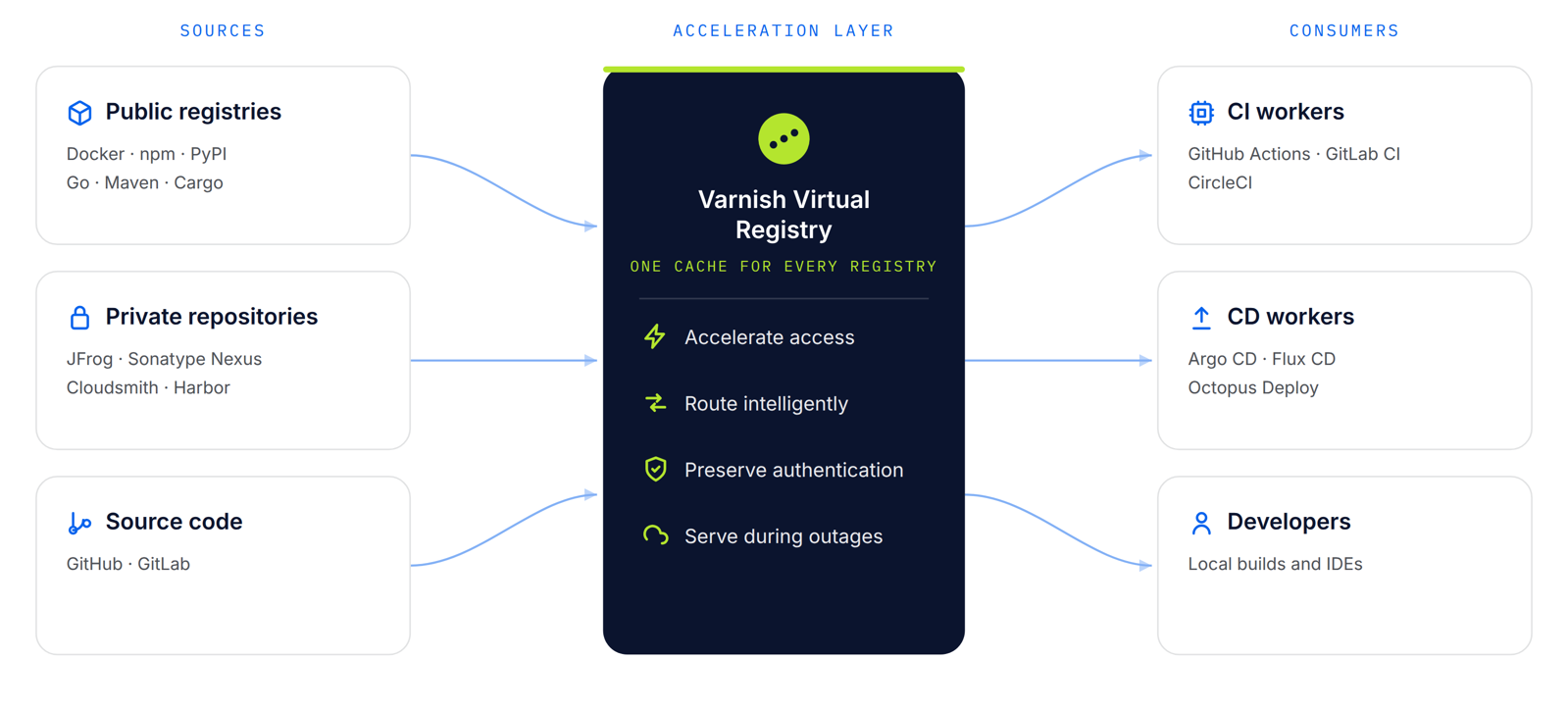
One acceleration layer between every registry you pull from and everything that pulls from it: CI, CD, and developers.
“Varnish has allowed our on-prem Universal Repository deployments to support workloads from our large in-house compute farm which support our quants who run huge batch jobs. It has also allowed us to improve performance of PyPI and NuGet repos and replace our use of httpd to load balance between repository servers with a single Varnish Layer.”

Compute Platform & Build Infrastructure at Technology and Research firm
Capabilities
What Virtual Registry does
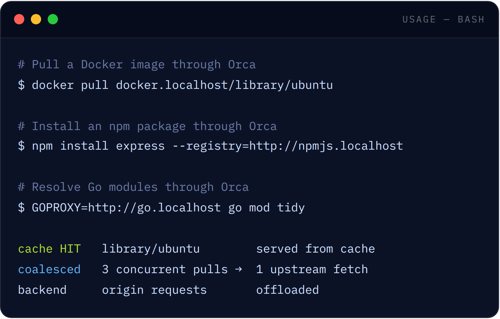
A single cache in front of every registry
Point your package managers and clients at a Virtual Registry endpoint and it does the rest: a cache lookup, a single upstream fetch, and repeated pulls served without touching the origin.
01
Artifact-aware acceleration |
Caches container layers, package files, binaries, Git LFS objects, and model artifacts, while keeping metadata, manifests, and indexes fresh with revalidation. |
REQUEST COALESCING PERSISTENT CACHING |
02
Multi-registry routing and virtualization |
Presents your repositories, registries, object stores, and cloud artifact services through one logical endpoint. |  |
03
Authentication-preserving private caching |
Accelerates private artifact traffic without bypassing registry security. Pairs with Artifact Firewall for request-time package policy. |
PRESERVES ACCESS SHARED EFFICIENCY |
04
Operational visibility and flexible deployment |
Built for platform teams running distributed delivery infrastructure. |
OPENTELEMETRY RUNS ANYWHERE |
Where Virtual Registry pays off
Reach for Virtual Registry wherever repeated artifact traffic is slowing builds, loading origins, or running up cost across distributed software delivery.

Accelerate CI/CD dependency fetches
Serve packages, containers, and modules from cache so runners stop waiting on upstream registries.

Shield origins during outages and migrations
Keep serving cached artifacts when registries, object stores, or networks are slow, overloaded, or being moved.

Cache private artifacts without duplication
Let approved users and runners share cached private binaries while upstream access controls stay intact.

Serve multi-region build infrastructure
Put a cache close to every region, runner, and cluster without centering delivery on one vendor.

Feed AI and model workloads
Shield object storage and accelerate both model delivery and the build and packaging of models themselves.

Replace fragile cache workarounds
Swap brittle NGINX, Squid, or httpd proxies for a purpose-built, artifact-aware acceleration layer.
Results
Proven in production
Across distributed CI/CD, multi-region build infrastructure, and compute-heavy environments, teams use Virtual Registry to cut backend load and cost while builds get faster and more reliable.
90%+
70%+
50%+
40%+
- Quantifiable performance improvements → Weeks of developer time saved
- Immediate OPEX reduction → Rapid, demonstrable ROI
Start your free trial in minutes
Get full Virtual Registry Premium and Artifact Firewall free for 30 days. Request your license, install Virtual Registry on your platform, and point a client at it to see two things on your own traffic: packages accelerating, and a package blocked by your policy at request time.

Built for
Built for platform, DevOps, and reliability teams
Platform engineering
DevOps and CI/CD
Faster dependency fetches, package restores, container pulls, and Git/GitHub acceleration across every runner.
SRE and reliability
FinOps and cost optimization
Specifications
Ecosystem and deployment support
Virtual Registry supports a broad range of artifact types and sources, and deploys wherever your artifact traffic flows.
Supported artifact types
Docker / OCI images, Helm charts, npm, PyPI, Maven, NuGet, Cargo, Go modules, Ansible, Conan, Debian, RPM, Git, Git LFS, and other HTTP-delivered immutable assets.
Supported sources
Deployment
Horizontal scale with no shared state.
Pairs with
Varnish Artifact Firewall, so the same access layer can accelerate delivery and enforce package policy at request time.
FAQ
A virtual registry is a caching and routing layer that sits in front of the registries you already use, rather than replacing them. Varnish Virtual Registry, also known as Orca, accelerates dependency resolution across every source you pull from without locking you into one vendor's backend.
Point your package managers at a Virtual Registry endpoint. It caches container layers, packages, and other artifacts close to where builds run, so repeated pulls are served locally instead of hitting the origin registry every time. Customers typically see over 90% less backend repo traffic and 40%+ faster dependency resolution.
Yes. It preserves upstream authentication, validating requests against your existing access controls before serving, so approved users and runners can share cached private artifacts without any per-user duplication.
It supports Docker and OCI images, Helm charts, npm, PyPI, Maven, NuGet, Cargo, Go modules, Ansible, Conan, Debian, RPM, and Git or Git LFS, across sources including JFrog Artifactory, Sonatype Nexus, GitHub Packages, Docker Hub, and major cloud registries.
Yes. By resolving up to 75% of repetitive platform and repository requests locally, Varnish minimizes cross-region network round-trips. This reduces variable cloud data transfer fees by up to 50% and defers the need for expensive storage and origin hardware scale-outs.
Yes. Virtual Registry is free for 30 days, and the trial also unlocks Varnish Artifact Firewall so you can test acceleration and dependency policy enforcement together.
Varnish Virtual Registry is free for 30 day trial period. The trial license also unlocks Artifact Firewall so you can experience both solutions together.
Varnish Virtual Registry the current name for the solution formerly known as Varnish Orca.

The Varnish Book
The Varnish Book is a practical book full of tips and best practices for getting the most out of your Varnish setup and reaching new heights in your caching operations, whether you’re new to Varnish or an experienced pro. Start your free trial here.

Dig Deeper

Documentation
Architecture, configuration, and operational behavior.

Tutorial
Step-by-step guides for accelerating Docker, npm, Go, Helm, and more.

Configuration reference
Full reference for registries, remotes, routes, and runtime options.

GitHub
Source, sample configuration, and integration examples.

Helm chart
Deploy and configure Virtual Registry on Kubernetes.
Where it fits
Explore related solutions
Varnish supports broader platform, delivery, and security initiatives across your software supply chain.
Varnish AI Accelerator ↗ Software supply chain security ↗ Storage cost optimization ↗ Origin and application protection ↗ Web & API performance ↗
Start accelerating your artifact delivery
Get full Virtual Registry Premium free for 30 days. Enter your email, get your license key, deploy in minutes, and follow a tutorial to see the acceleration on your own traffic. No pipeline changes, no sales calls. Your trial unlocks Varnish Artifact Firewall too.